At a Glance: Mylar Bags vs Vacuum Sealing
- Vacuum sealing is a mechanical process that removes air from a plastic channel bag, while a Mylar bag is a high-barrier container made of metalized film that functions as a flexible tin can.
- Mylar bags provide a total light and oxygen barrier suitable for 10–25 years of storage; vacuum seals use porous plastic that allows oxygen to slowly leak through, limiting shelf life to 1–3 years.
- Use vacuum sealing for items in the fridge or freezer you rotate frequently and use Mylar bags for your “long-term reserve” of dry staples like rice and beans.
RELATED: The Best Emergency Food Storage Kits for a Family of 4 (2026 GUIDE)
Jump to:
When you look at the world today, it is not paranoia to see that centralized systems from grocery store shelves to the utility grid are more fragile than most people care to admit. You likely hold the mental load of your family’s safety every single day, managing household resilience with the same quiet competence you use for the grocery list or the school calendar.
One of the most critical parts of that resilience is your “food insurance.” But there’s a massive difference between storing food for a weekend camping trip and building a 20-year reserve that can weather a true crisis. In the debate of Mylar Bags vs. Vacuum Seals, choosing the wrong one could mean opening a bag of spoiled grain exactly when your family needs it most.
What’s the difference between Mylar bags and vacuum seals?
This section explores the mechanical removal of air versus the creation of a total environmental barrier, helping you choose the right tool for your family’s practical competence.
- What is Vacuum Sealing? Vacuum sealing is a mechanical preservation process that removes air from a specialized plastic channel bag before applying a heat seal to the opening.
- What are Mylar Bags? A Mylar bag is a high-barrier storage container made from metalized polyester film (BoPET), functioning essentially as a flexible tin can that blocks light, moisture, and gases.
- The “Mylar vs Vacuum Seal” Reality: Mylar bags are superior for long-term storage because the metalized layer creates a gas-impermeable barrier that plastic vacuum bags lack. While vacuum sealing is an exercise in practical mastery for the weekly grocery run, it is not a “forever” solution for deep storage.
How long does food last in Mylar bags vs in vacuum seals?
Choosing between these two is about the “dollar-per-value” of your security and ensuring your vigilance is rewarded with viable nutrition years down the line.
Name
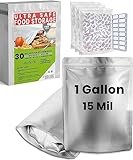
30 Mylar Bags for Food Storage 1 Gallon – Extra Thick 15 Mil – Long Term & Food Grade – Mylar Bags…
MEGAWISE 2025 Powerful Vacuum Sealer Machine | Compact Design | One-Touch Automatic | Seal in…
Preview


Primary Goal
Decadal-Level Preservation
Shelf Life
10–25 Years (Professional)
Oxygen Barrier
Excellent (0.1% Oxygen level)
Fair (Plastic leaks over time)
Puncture Resistance
Low (Sharp food can poke holes)
Name
30 Mylar Bags for Food Storage 1 Gallon – Extra Thick 15 Mil – Long Term & Food Grade – Mylar Bags…
Preview
Primary Goal
Decadal-Level Preservation
Shelf Life
10–25 Years (Professional)
Oxygen Barrier
Excellent (0.1% Oxygen level)
Name
MEGAWISE 2025 Powerful Vacuum Sealer Machine | Compact Design | One-Touch Automatic | Seal in…
Preview
Oxygen Barrier
Fair (Plastic leaks over time)
Puncture Resistance
Low (Sharp food can poke holes)
Last update on 2026-03-06 / Affiliate links / Images from Amazon Product Advertising API
Are Mylar bags better than vacuum sealing for rice and beans?

For those looking to build a multi-decade food reserve, Mylar represents the gold standard in protective technology for dry staples like white rice, beans, and flour.
If a vacuum seal is for next season, a Mylar bag is for next decade. To achieve professional-grade storage, Mylar bags are paired with Oxygen Absorbers (OAs). These small packets bring the oxygen level inside the bag down to 0.1%, an environment where pests and bacteria cannot survive.
Mylar is also opaque. Light destroys the nutritional value of food over time, and because vacuum bags are clear, they offer zero protection. Mylar acts as a blackout curtain for your calories, protecting the “mastery” you’ve invested in your food supply.
When to use Mylar Bags or Vacuum Sealing for food storage?
The most effective preparedness is often invisible, blending into the home as organized pantry management to avoid the social stigma sometimes associated with survivalism.
We know that prepping can sometimes carry a social stigma that you would rather avoid. The key to successful stealth preparedness is choosing tools that have “cover” in categories like kitchen or garden supplies:
- Vacuum Sealing looks like standard kitchen organization; it is viewed as “normal” and passes the “spouse test” for those with a normalcy bias.
- Mylar Bags can be tucked into standard 5-gallon hardware buckets. To the outside world, it looks like extra salt or gardening supplies, but to you, it is a 25-year family security plan.
Why do vacuum bags eventually lose their seal?
In a crisis, a failed seal is a failed plan. Mastering these technical nuances ensures your family remains rational and capable when others are panicking.
According to USDA food safety guidelines, low-acid foods in anaerobic environments require strict adherence to moisture protocols. When you are the “last line of defense,” you cannot afford a gear failure. Avoid these critical mistakes:
- The Porosity of Plastic: Standard vacuum bags are microscopic-ally porous. Over time, oxygen molecules will slowly leak through the material.
- Pinhole Leaks: Dry beans and pasta have sharp edges. When a vacuum sealer pulls the plastic tight against these edges, it often creates tiny pinhole leaks. Mylar is significantly thicker and resists these punctures.
- The “Wet Food” Danger: Never use Mylar or Oxygen Absorbers for wet or oily foods (like brown rice or wet jerky) unless they have been professionally freeze-dried. This can create a risk of botulism in an oxygen-free environment.
Mylar Bags vs Vacuum Seals: What’s the Final Verdict

Use Vacuum Seals for your “Active Pantry”or the foods you rotate through every few months. It saves money, reduces waste, and keeps your kitchen organized.
Use Mylar Bags for your “Long-Term Reserve.” When you seal white rice or pinto beans in Mylar with an oxygen absorber, you are creating a “time capsule” of nutrition that will be there for your children even decades from now. This also supports your pharmaceutical independence plan by protecting medicinal plants and home remedies from degradation.
Print and put this checklist on your fridge so you won’t forget!
DOWNLOAD THE FREE LONG-TERM STORAGE CHECKLIST HERE
FAQ: Mylar Bags vs Vacuum Seals
Q: Can I use oxygen absorbers in vacuum bags?
A: It is generally not recommended. Standard vacuum bags are porous; the absorber will quickly exhaust itself trying to “fix” the air leaking through the plastic.
Q: Does vacuum sealing prevent botulism?
A: No. In fact, removing oxygen can encourage Clostridium botulinum in moist foods. Only use vacuum/Mylar for dry goods or properly frozen items.
Q: Is Mylar more expensive than vacuum sealing?
A: Initially, yes. However, Mylar is more cost-effective for long-term reserves because it prevents food spoilage and waste over decades.