Lindsay Fitzclarence‘s travelogue “The Dirty Life of Mining in Australia” is a thought-provoking work that combines social, economic, industrial, indigenous, and environmental perspectives into a journey across Australia. Occupational health and safety (OHS) is one theme, but it is part of many, and the book is better for it.
Fitzcalrence’s multifaceted perspective prevents the book from becoming a critique of the evils of extractive industries, although the industry’s damage is not glossed over. The catalyst for the book was the 2014 Hazelwood mine fire. He was born in Morwell, which is adjacent to the mine, and only left the area formally in his late teens to study. He understands the culture of traditional towns, especially those towns that rely almost entirely on a single source of employment and wealth. One summary of his book accurately says Fitzclarence:
“….aims to challenge the narrative of mining as a symbol of human progress and advocate for alternative narratives and practices to address the environmental damage and social consequences of mining.”
Chapter Two, following a discussion on the Hazelwood fire, discusses responsibility. He looks at who was responsible for the health and safety of workers, emergency responders, and the community, and at corporate actions regarding the environmental future and the removal of safety measures that the fire proved to be essential. He wrote:
“A Supreme Court ruling in May 2020 resolved the matter of payment for the costs of managing the fire. Several utilities, working on behalf of the company, were charged a total of almost $2 million. The fine was a recovery for health and safety breaches and for the effects of pollution created by the fire. Environment groups were quick to point out the glaring discrepancy between the relatively small fine and the costs of fighting the fire and cleaning up after it. Other members oflocal advocacy groups also noted the inadequacy of the fine, given the ongoing health problems generated by the fire and the associated airborne pollution.” (page 25)
This paragraph is a good example of the book’s tone and the integrated considerations that reflect the modern approach to OHS, where the effects of work processes on neighbours and other stakeholders must be taken into account when identifying safe work practices. The environmental and occupational health laws have rarely been more compatible.
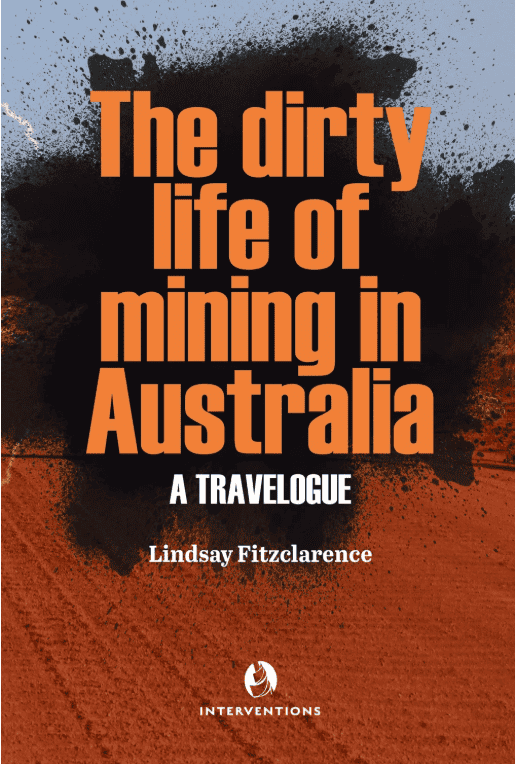
Fitzclarence travels across the country; after all, the book is a travelogue, and concludes that the extractive industries have left behind damaged landscapes, polluted ecosystems, and communities grappling with health issues, economic instability, and social challenges. But it is not as if large-scale mining is over. The development of renewable energy sources and storage risks reviving destructive practices under the guise of sustainability. Rather than repeating damaging errors, mining could evolve to use ethical, environmentally conscious practices for the in-demand critical earth minerals, while still maintaining profitability. OHS obligations should be part of this evolution.
The book is not a diary of a four-wheel-drive trek through rural parts of Australia, recounting flat tyres and bogged vehicles. There is none of that. It is an observational tale of mining and a recontextualising of that industry through modern 21st-century eyes and values. Although mining has been vital to Australia’s economy for decades, it has not been without social and environmental cost, and there is a high risk of perpetuating this damage. Fitzclarence draws on many information sources for the history of mining, the current context and possible futures. He has produced a book about an informed journey through some of the most beautiful and ugliest parts of Australia.
Kevin Jones

