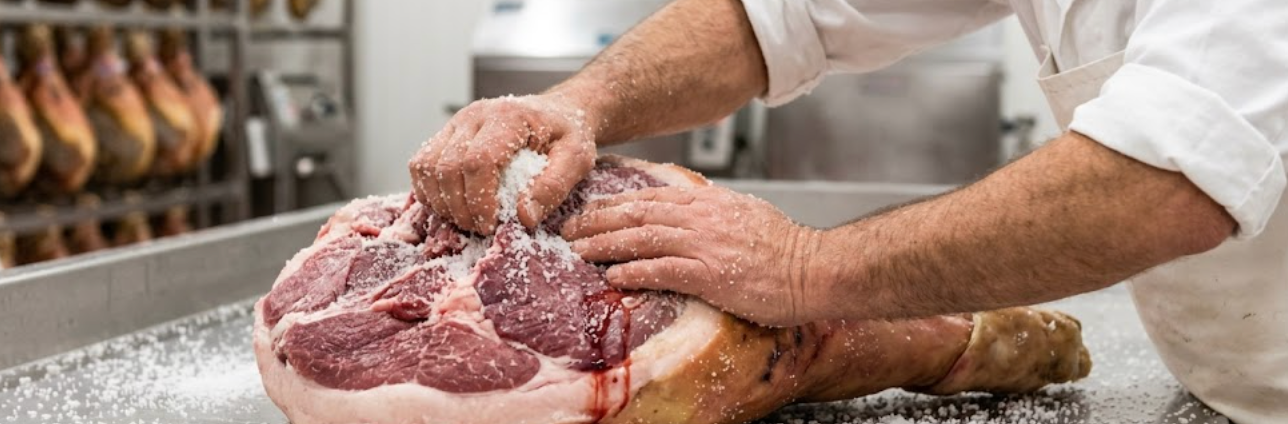
At a Glance: Salt curing meat is a preservation method that uses salt to remove moisture via osmosis, lowering water activity to prevent bacterial growth. Key steps for dry curing meat at home include a heavy salt rub, cold curing at 36°F–40°F, and air-drying until the meat loses 35% of its original weight. Whole muscles are generally safe with salt alone, but according to USDA safety standards, ground meats require nitrates to prevent botulism.
Why is Salt Curing Meat Essential for Survival?

In a long-term grid-down scenario, your freezer is a liability. Once the power fails, you have roughly 48 hours before your protein assets become a biohazard. Meat preservation without refrigeration is the only way to lock in calories for 6 to 12 months.
Supplies Needed for Salt Curing Meat
- Non-iodized salt: Coarse sea salt or Kosher salt (Avoid table salt with additives).
- Digital scale: Must be accurate to 0.1g for weight-loss tracking.
- Breathable wrap: Cheesecloth or muslin.
- Non-reactive container: Glass, food-safe plastic, or stainless steel.
- Cool environment: A space maintaining 36°F–40°F for the initial cure.
How Does Salt Curing Meat Work?
Salt curing works by dehydrating meat through osmosis to create an environment where bacteria cannot physically survive. When you pack a cut in salt, the high concentration on the outside forces moisture out of the muscle fibers while drawing salt inward. This process effectively lowers the “water activity” of the meat; since spoilage-causing microbes require a specific level of moisture to hydrate and reproduce, the “Salt-Shield” renders the protein biologically inert.
Is Salt Curing Meat Safe for Long-Term Storage?
Yes, salt curing is safe for long-term storage provided you match the curing method to the specific type of meat. For whole-muscle cuts like hams or loins, salt alone is a sufficient barrier against spoilage if you hit the 35% weight-loss target. However, safety margins change for ground meats:
-
Whole Muscles: Safe to use salt alone. The dense structure of a whole muscle prevents oxygen from reaching the center, and the salt penetrates before surface bacteria can migrate inward.
-
Ground/Punctured Meats: These require nitrates (Pink Salt #2). Grinding meat introduces oxygen and surface bacteria into the center of the mix, creating a high-risk environment for Clostridium botulinum (botulism) that salt alone cannot reliably neutralize.
The Golden Rule: Never attempt to cure ground or punctured meat without nitrates. For whole muscles, the “Salt-Shield” is sufficient if environmental controls are met.
What is the Best Process for Curing Meat at Home?
We utilize a 3-Layer Storage Protocol to ensure the salt penetrates the core before the surface can spoil.
- The Clean Prep: Trim excess fat (fat does not cure well and can go rancid) and weigh the meat.
- The Salt-Box Rub: Cover the meat entirely in salt. Use the 1/3 Rule: Ensure the salt layer is at least one-third the thickness of the meat itself.
- The Cold Cure: Store the meat at 36°F–40°F (2°C–4°C). Flip the meat daily and pour off accumulated liquid.
- The Rinse and Wrap: Once firm (approx. 1 day per pound), rinse off excess salt and wrap in cheesecloth.
- The Long Hang: Hang in a dark area with gentle airflow (55°F / 70% humidity) until it hits the target weight.
Once the “Rinse and Wrap” phase is complete, you need a reliable way to hang weight. These stainless steel S-hooks are non-reactive (crucial when dealing with salt) and can support heavy whole-muscle hams for the 6 to 12 months required for total shelf stability.
Last update on 2026-04-03 / Affiliate links / Images from Amazon Product Advertising API
How Can You Tell if Cured Meat Has Gone Bad?
Do not rely on the “smell test.” By the time you smell rot, the toxins are already present. You must use the Go/No-Go Weight Gate.
Warning: If the outside felt like leather but the inside was a grey, stinking mush. This is “Case Hardening.” It happens when the outside dries too fast, trapping moisture inside and allowing anaerobic bacteria to bloom. If your meat hits the weight goal too quickly (under 14 days for a large cut), you likely have a hollow, rotten center.
The 35% Math Box
Use this formula to determine when your meat is shelf-stable:

-
Example: You start with a 5lb (2268g) pork loin.
-
The Calculation: $2268 \times 0.65 = 1474.2$
-
The Goal: Your meat is not safe to eat until the scale reads 1474g or less.
A standard kitchen scale that rounds to the nearest ounce is useless here. You need a high-precision digital scale to ensure the weight loss is tracked to the gram. Here’s what I use:
Last update on 2026-04-03 / Affiliate links / Images from Amazon Product Advertising API
Frequently Asked Questions (FAQ)
Q: Can I use table salt for curing meat?
A: No. Iodized table salt contains anti-caking agents and iodine that create a bitter, metallic taste and can interfere with the chemical process. Use coarse sea salt or Kosher salt.
Q: What is the best temperature for salt curing?
A: The “Cold Cure” phase must be between 36°F and 40°F. If it is too cold (freezing), the salt won’t penetrate. If it is too warm (above 45°F), the meat will spoil before the salt can shield it.
Q: How do I prevent case hardening?
A: Maintain humidity between 60% and 75%. If your environment is too dry (like a modern frost-free fridge), the surface will seal. If this happens, vacuum seal the meat for 7 days to “equalize” the moisture, then resume hanging.