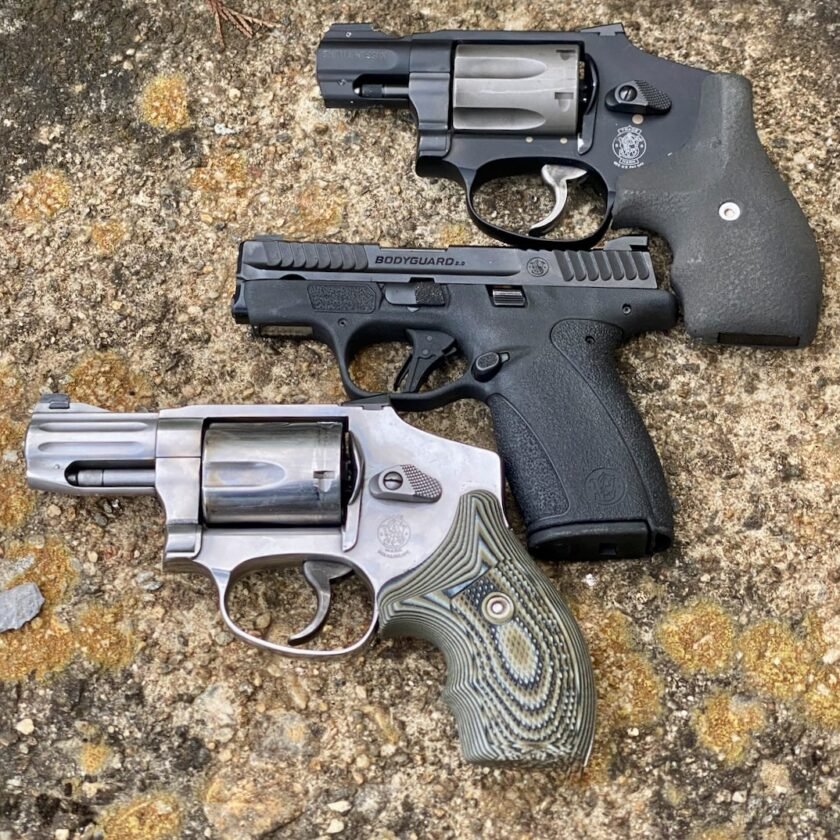
The J-Frame revolver is widely regarded as a go-to deep concealment/NPE/backup gun candidate. For as long as I’ve thought about working in law enforcement, I’ve imagined carrying a J-Frame as a BUG. This was before the Bodyguard 2.0 came along, however. Though my initial review wasn’t glowing, the BG 2.0 has grown on me. I think this pistol is a game-changer, and to steal a term from Dr. Sherman House, it is the real 21-st Century J-Frame. Read on as I compare the S&W Bodyguard 2.0 vs. J-frame revolvers.
S&W Bodyguard 2.0 vs. J-Frame Revolvers
The J-Frame revolver is certainly venerable, coming into existence three-quarters of a century ago. The J-Frame quickly became the standard by which all other small-frame revolvers were judged. Originally equipped with a 5-shot cylinder chambered for .38 special, J-Frames are also available in .22 Long Rifle, .22 Magnum, .32 H&R Mag, .357 Magnum, and 9mm. Double-action-only models outnumber DA/SA guns four to one in the current S&W catalog. The J-Frame certainly has some compelling attributes, but it also hasn’t advanced much since 1950.
The S&W 432 Ultimate Carry
This review will specifically compare the Bodyguard 2.0 with the S&W/Lipsey’s Ultimate Carry revolvers. The reason is that these are the most modern revolvers available. When stepping back to the “standard” revolvers, users must necessarily accept subpar sights and S&W’s the Internal Locking System. The triggers on recent-vintage S&W revolvers has been nothing to write home about, either.

Comparing the Bodyguard 2.0 with the Ultimate Carry line – and especially the Titanium models – will offer the closest possible comparison. These revolvers are top-tier, which may seem like a false comparison. However, they have high quality sights (very similar to those on the Bodyguard) that are absent on more pedestrian S&W small-frame revolvers. I’m going to focus on the .32 H&R Magnum-chambered version, but versions are available in .38 Special, as well.

The Bodyguard 2.0
The S&W Bodyguard 2.0 was released in mid-2024. I was an early adopter, and seem to have gotten a good sample. The BG 2.0 is a micro-compact, double-stack, .380 pistol. Somehow, Smith & Wesson really hit it out of the park with this one. While being absolutely tiny, the gun has an extremely workable grip. Ironically, there is more gripping surface on this tiny gun than on my S&W model 3913, a substantially larger pistol. Not to let the cat out of the bag, but his thing seems like a quantum-leap forward from the little J-Frame.

The Bodyguard 2.0 also uses a double-ish stack magazine to put 10 rounds in the grip of this tiny gun. Even better, it has a tilting-barrel design. I had some complaints about the initial sighting setup on these guns, but XS answered with a set of sights with a smaller rear notch and a better front sight. After swapping out the sights I have found this gun to be a winner. And I put my money where my mouth is and carry this in an ankle holster, on duty, every single shift.

We will examine these revolvers on the characteristics of size and weight, capacity, cost, and ammunition cost. I will also candidly discuss the pros and cons of each.
Capacity
I’m not the most capacity-oriented guy. I carry a 8+1/10+1 1911 in my off-duty time. The higher your level of skill, the less important capacity is, and I have a fairly high level of skill. I don’t feel that I’m doing myself a disservice by carrying a sub-10-round gun. All other things being equal, however, more is better, and there are other factors to consider, i.e. how quickly and easily can the gun be reloaded.

When it comes to capacity, the BG 2.0 is objectively better. A few years ago I would have said that a 5-shot .38 is in the same class as a 6+1 Ruger LCP. Nowadays, though, the BG 2.0 radically outclasses the J-frame revolver with a 10+1 flush-fit magazine. Even better, the BG 2.0 comes with an extended, 12-round magazine. To be clear, the rounds in the gun are more important than the reload on your belt.
However, a 5- or 6-shot revolver is working on the ragged edge of capacity. The fewer rounds you have on board, the more likely you are to need a reload. That’s only 5 or 6 chances to end the fight. Handgun calibers usually take several shots to convince someone to stop trying to kill you. Five or six will probably get the job done. Probably. And and then there’s the issue of multiple attackers. What if they both need four rounds to be convinced to move on? What if the first guy needs 7? A revolver isn’t going to be your friend that day. Worse, the revolver is ploddingly slow to reload, even with the best possible speedloaders. They are also extremely complicated, especially so if you don’t carry a speedloader.

Winner: Though capacity isn’t everything, it is something and the Bodyguard 2.0 is a clear winner. It boasts over twice the capacity of a .38 J-Frame and almost twice that of a .32 H&R. The Bodyguard 2.0 can also be loaded far more easily and quickly than a revolver.
Size Comparison
One of the most compelling attributes of the J-Frame has always been its small size. For some considerable stretches of recent history it has been the smallest repeating firearm that is actually viable as a defensive arm. Weight is another matter. Steel-framed Js are not light. Loaded with five 135-grain .38 Special Gold Dots and wearing VZ Boot Grips, my 640 Pro weighs in at 25.2 ounces. That’s heavier than an unloaded Glock 19, only four or five ounces lighter than a loaded one!

But we all know that lighter J-Frames are available, so lets compare apples to apples. I currently have in my possession a S&W 432 Ultimate Carry Ti. This 6-shot .32 H&R Magnum is definitely on the lighter end. Wearing Hamre Forge AFR Undercover grips (maybe the best J-Frame grips ever!) and loaded with six Federal HS-Deep 85-grain JHPs it comes in at 15.3 ounces. That’s much more reasonable, and a perfectly carryable revolver. A gun this light could be carried in just about any position without major inconvenience.

Weight Comparison
Now let’s look at the Bodyguard 2.0. The weight of the Bodyguard 2.0 is so close to that of the 432 UC Ti it’s almost too close to call. My kitchen scale puts the fully loaded (10+1) Bodyguard 2.0 at 15.4 ounces – one-tenth of an ounce heavier than the 432 UC. I would call that a draw…and that’s with the lighter, titanium-cylinder J-Frame. The non-Ti revolvers weight about 3 ounces more. This may seem trivial, but is about 1/5th of the gun’s overall weight.

Next, it is smaller than a J-frame, in every dimension. The overall length of the Bodyguard 2.0 is 5.5 inches, over half an inch shorter than a J-Frame wearing boot grips. Throw on those AFR grips and the length difference widens. The BG 2.0 is also a third of an inch shorter in height. But the real difference is in thickness. The cylinder of the revolver makes it 1.3 inches wide. The BG 2.0 is only .88 inches wide. That’s a huge difference when looking at carrying in a true non-permissive environment. Though hard to convey in photos, the revolver is much bulkier than the Bodyguard 2.0.

Winner: Bodyguard 2.0. The weight is almost identical to the 432 UC Ti, but the BG 2.0 is substantially smaller.
What About Reliability?
Revolvers are supposed to be the ultimate in reliability, the “six for sure” guns. Revolvers are also frequently touted as robust due to their supposed simplicity. Unfortunately, I’ve had terrible reliability with the revolvers lately. Quality control issues are plaguing revolver manufacturers all over the place. The most egregious I’ve seen were two back-to-back samples of the S&W/Lipsey’s 432 UC Ti.
I was given the opportunity to review the 432 Ti for RevolverGuy (review coming next Saturday – check it out!). The first sample had several light strikes with .32 S&W Long and .32 H&R Magnum ammo. The pin holding the front sight in walked out, and the cylinder latch almost fell off because its nut walked off. The revolver also had a catastrophic malfunction relating to the trigger (details in the RevolverGuy article!).So I sent it back. The sample I received did not have this issue and I was mostly satisfied with it. Until about 200 rounds in, that is. I was performing a reload. I slapped the ejector rod and the whole cylinder was pushed back past the cylinder stop.

Some revolvers are reliable. My 640 Pro Series has been very dependable. If I were choosing between a new revolver and a new semi-auto, though…it would be hard to convince me to buy a new revolver.Conversely, small semi-autos have a reputation for being unreliable. That is not the case with the Bodyguard 2.0, however. My personal sample has so far gone 950 rounds without a single bobble. No jams, stovepipes, failures to feed or extract, double-feeds, hiccups, stoppages or any other failures to operate as intended. It has fired everything I have put through it. What more do I need to say?
Obviously you could get a bad Bodyguard 2.0. there are also complaints about the BG 2.0 quality control out there. but I think the odds are significantly lower than those of getting a bad J-Frame…at least under current manufacturing and QC practices. However, the BG 2.0 is at least as reliable as the 432 UC, and in my instance, far more so.
Revolver Advantage in Hands-On Fights?
One of the most common praises a revolver receives is that they don’t go out-of-battery when making a contact shot. The theory is that in a hands-on fight you can draw your revolver, shove it into someone’s belly, and since it doesn’t have a slide, the slide won’t be pushed out of battery. I don’t necessarily disagree with this. The revolver does have other disadvantages, though. If a bad guy manages to put his hands around your revolver, he doesn’t have to grip very hard to completely lock up the cylinder. This prevents the revolver from firing until he lets go.
The same is true of a semi-automatic, with one critical difference. With the semi-auto you can at least get one shot off. I think this disadvantage negate the contact-shot advantage. If I had to fight for my gun, I’d take the Bodyguard 2.0. The very low bore axis, combined with the shorter overall package means I can have my hand on a substantially larger portion of the gun. I believe it would be far more easy to hold onto than a J-Frame revolver – there’s just way more meat on the grip of the gun, and a smaller portion of the gun for a bad guy to grab onto.
I’m not the expert so I’m not going to make a firm judgment. However, my gut says the edge goes to the BG 2.0.
Gun Cost
Cost isn’t everything when it comes to a defensive handgun. I believe that you should buy the best firearm you can afford. The Bodyguard 2.0, however, costs half as much as some J-frames. With retail prices coming in right around $400, the Bodyguard 2.0 is a no-brainer.

Street prices for the non-titanium Ultimate Carry J-Frames seem to be right around $700. The titanium models go up another $50 to 100. Paying $700 for a revolver is a 75% upcharge, and $800 is literally double the cost.

If the revolver brought a lot to the table that the semi-auto didn’t, I’d totally understand, but it seems outclassed in every way. I can’t understand why you’d spend nearly twice as much on the revolver with options like the Bodyguard 2.0 out there.And that’s just for the gun. Ammunition for the revolver calibers is is also more expensive.
Ammunition Cost
The cost of the gun is one thing, and ammunition cost is another. In the seven years that I’ve been carrying my EDC pistol, I’ve put over 16,000 rounds through it. That’s 16 cases of ammo. In present-day dollars that would cost me $3,664…and I have a whole lot more shooting planned. Shooting even a modestly more expensive cartridge takes a big toll over time.
Let’s see what that would cost in .380, and compare that to .32 H&R Magnum and .38 Special. I turned to SGAmmo.com, a trustworthy site where I’ve bought most of my ammo for the past decade. Ammo for .380 is definitely more expensive than 9mm, but it is still fairly affordable. A case of .380 Auto goes for $299, or $0.30/round. Cases of .38 Special are more expensive, with the cheapest offering ringing up at $369/case, or $0.37/round.
That may not seem like a big difference, but over 10 cases, that’s a $700 difference, or 2 1/3 cases of .380 ammo. That’s 2,300 more rounds of training ammo, which used properly could make a huge difference in your skill level.

When we get into .32 H&R Magnum ammo costs skyrocket. Costs for .32 H&R ammunition on SGAmmo run $1.20 to $1.3o/round. That means a “case” of 500 rounds costs $569! For the cost of that case you could almost buy two cases of .380 ACP – FOUR TIMES the ammunition. Some smaller companies like High Desert Cartridge Company are manufacturing this round at slightly cheaper costs, but it is still expensive. These rounds run from $0.84/round to $1.04/round. Of course you could dry practice a bunch and save money…but you can also do that with a semi-auto.
Ammunition Availability
And there’s the availability issue. The .32 H&R Magnum has experienced a revival in the last couple of years. Probably more ammo has been made for the in the last year than in the last 25 before that. Unfortunately it is still a long, long way from being mainstream. Your odds of finding a box at the local gun shop are pretty low. The odds of losing all access if we have another big run on ammo is, unfortunately, pretty high. I would be exceedingly hesitant to get into a .32 H&R revolver, at least until ammo prices drop considerably.
Lucky Gunner shows 98 different options for .38 Special ammunition. they show 55 different offerings in .380 Auto. Meanwhile, there are only six options in .32 H&R Magnum, nine in .32 S&W Long, and 1 in .32 Short. All together that’s only 15 ammo options for .32 H&R-chambered revolvers. SGAmmo shows only four .32 H&R loadings and five .32 S&W Longs. AmmoToGo offers 6 H&R Mag, 7 S&W Longs, and 1 .32 Short. Like Lucky Gunner, SGAmmo and AmmoToGo offer dozens of .38 and .380 loadings (and scores of 9mm).
Keep in mind that the .32 Long and Short loadings are likely to be unreliable in some guns. They were in both of the 432 UC Ti samples that I shot, so they can’t be depended on. Also again, bear in mind the cost of this ammo. Due to its very limited availability I would recommend laying in a good supply, but 1,000 rounds will cost you about $1,000. Not to beat a dead horse but for the same money you could buy 4,000 rounds of 9mm, 3,000 rounds of .380, or 2,000 rounds of .38 Special.
The *Real* 21st Century J-Frame
Several years ago, Dr. House wrote an article calling the Sig P365 the 21st Century J-Frame. Though I have utmost respect for Dr. House, I respectfully (and good-naturedly!) reject his comparison. While certainly more capable than a J-Frame, the P365 is also bigger and heavier. If the gun is larger, of course it should have more capability!

The Bodyguard 2.0, on the other hand, is much smaller than the J-Frame revolver. It is also just as light as most lightweight models and substantially lighter than all-steel guns. Loaded it is an ounce or two heavier than the uber-lightweight Js, but those are generally fairly unpleasant to shoot. The Bodyguard 2.0 carries like a dream and shoots extremely well. It has a 10+1 or 12+1 capacity, and shoots affordable and readily available .380 ACP ammo.