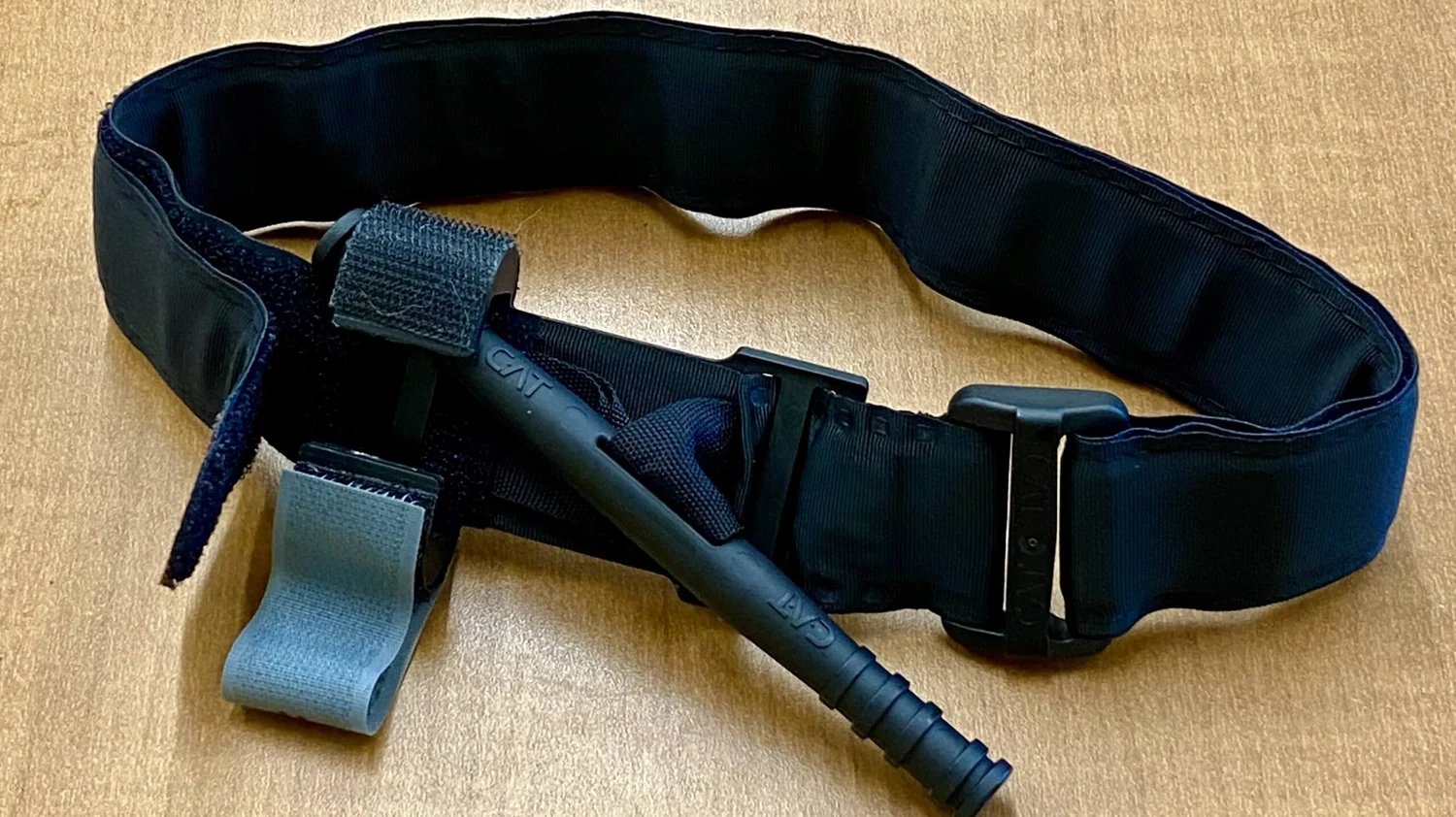
Let’s put this into some real-world terms: in five years of working on a 911 ambulance, I’ve only had to resort to a tourniquet one time. Yes, just once. Out of countless motor vehicle collisions, falls, stabbings, gunshot wounds, workplace accidents, etc., I have been able to control bleeding (including arterial bleeding) using direct pressure, pressure dressings, and wound packing, except in one case. In that one case, a woman’s leg had literally been torn from her body by a piece of machinery. For everything else, including extremity hemorrhage, a tourniquet was unnecessary.
Tourniquets Are Not Complication-Free
As I mentioned earlier, we’ve gotten over the “last resort” mentality of tourniquets that was so common in the 80s and 90s. When a tourniquet is indicated, it’s indicated and should be used immediately! Like any medical intervention however, the tourniquet should NOT be used when contraindicated. Why? First, tourniquets are not totally benign instruments, free of medical complications.
When you apply a tourniquet to an arm or leg, the tissue in that extremity can no longer get oxygen or offload carbon dioxide. This creates a profound metabolic imbalance. If the tourniquet is suddenly removed (intentionally or accidentally), the patient may go into sudden cardiac arrest. Is it worth creating this small but potentially fatal risk for anything short of an uncontrollable, arterial bleed? No, but I’ve seen tourniquets applied to wounds that could have been handled with a roll of gauze, needlessly risking this complication.
If bleeding can be controlled by other, lesser means, then other, lesser means should be utilized. We should strive to use the least invasive, least damaging method possible. Using a tourniquet on a minor wound is like pulling a pistol on someone who is merely flipping us off, or starting CPR on someone with a head cold: it is grossly out of proportion!
Tourniquets Impose Significant Financial Burden
Tourniquets also carry a huge financial cost. A trauma center will categorize any patient with a tourniquet applied as a “Code Trauma.” This is going to active a huge team of doctors, PAs, nurses, anesthesiologists, respiratory therapists, etc. The bill for a code trauma will probably start in the neighborhood of $10,000 (in my area it’s about $30K).
I know what you’re thinking: “I’d rather be alive to worry about money problems than dead with money in the bank!” True, but that misses the point. This isn’t zero-sum; if the patient doesn’t need a tourniquet, we don’t need to take it upon ourselves to double or triple the cost of his (or our own!) healthcare. If the wound will be adequately treated with some direct pressure, we don’t need to activate a trauma team, which is also a misallocation of precious medical resources…but that’s a discussion for another time.
Medically, we should always be operating with the mindset of “doing what is in the best interest of the patient.” Causing the patient to incur huge medical bills when a trip to urgent care and a couple stitches would have fixed them up is probably not in their best interest. Again, the tourniquet should only be applied when indicated. But if it’s all you go, then every medical problem starts to look like a tourniquet problem.
Tourniquet Do Not Suck at What They Do
I admit the title is a bit of clickbait…but only a bit. Tourniquets are really, really good at what they do. When the patient has a massive hemorrhage, a mangled limb, or a traumatic amputation, it’s the tool you want. A tourniquet will get the job done quickly, intuitively, and effectively. Unfortunately, if you have a wound to the head, neck, chest, abdomen, or groin, your tourniquet does absolutely nothing.
And if even the wound is to an extremity, in the absence of uncontrollable bleeding, we don’t need to risk compartment syndrome and a CODE TRAUMA activation by thoughtlessly slapping on a tourniquet. If direct pressure will do, don’t overdo with a tourniquet.
When all you carry is a tourniquet, it’s the only thing you have to fall back on. As a result, it will probably be overused and misused. In fact, I know it will because I have reduced tourniquets that were misapplied by law enforcement, firefighters, and yes, the average citizen.
What I Recommend for Medical EDC
I hate to complain about problems without offering solutions. So, here’s my recommendation. I have written before that I carry a triangular bandage. I called it the “medical multitool” because it does so many jobs. It can be an improvised tourniquet (it is probably the best improvised TQ), even though we recognize that the likelihood of truly needing a tourniquet is minuscule. The triangular bandage can also be a pressure dressing for a neck wound, a dressing for a head wound, padding for a splint, a sling, wound packing material… The list goes on and on.
But the $5 triangular bandage isn’t very sexy. So, instead, I offer you the OLAES Modular Bandage! It’s cool, its inexpensive, and it is a military medical product. You’ll get all the cool-guy points for carrying a “special ops-approved” medical intervention, but it will be far more useful than a tourniquet! Ok, serious again…let’s talk about why I recommend the OLAES Modular Bandage, and why I carry one in my cargo pocket on every patrol shift.
Better Than a Tourniquet for EDC: The 4″ OLAES Modular Bandage
The OLAES Modular Bandage is amazingly versatile! It functions as a standard pressure dressing and does so extremely effectively. The elastic band has a velcro strip every 10 inches to prevent the whole roll from spilling everywhere when the bandage is opened. Instead of a hook that must book looped through, there is a rigid cup that provides pressure over the wound. But that’s not all.